


Billie Eilish stood on the Grammy stage accepting the award for Song of the Year for “Wildflower.” The room was full of people who’d spent the evening celebrating music—Sabrina, Kendrick, Chappell, Addison and Bieber in his boxers. When it was Eilish’s turn to speak, she said what felt, in that moment, like the right thing to say.
“I honestly don’t feel like I need to say anything, but no one is illegal on stolen land,” Eilish began. “It’s really hard to know what to say and what to do right now. I feel really hopeful in this room and I feel like we just need to keep fighting and speaking up and protesting. Our voices really do matter and the people matter.”
Then the broadcast bleeped out what came next, though anyone watching could read her lips, and, well, because this is a family Substack, the pop singer was not suggesting the American people make sweet, tender love to ICE agents.
The room applauded. Her brother Finneas stood beside her. The moment was intended to read as significant.
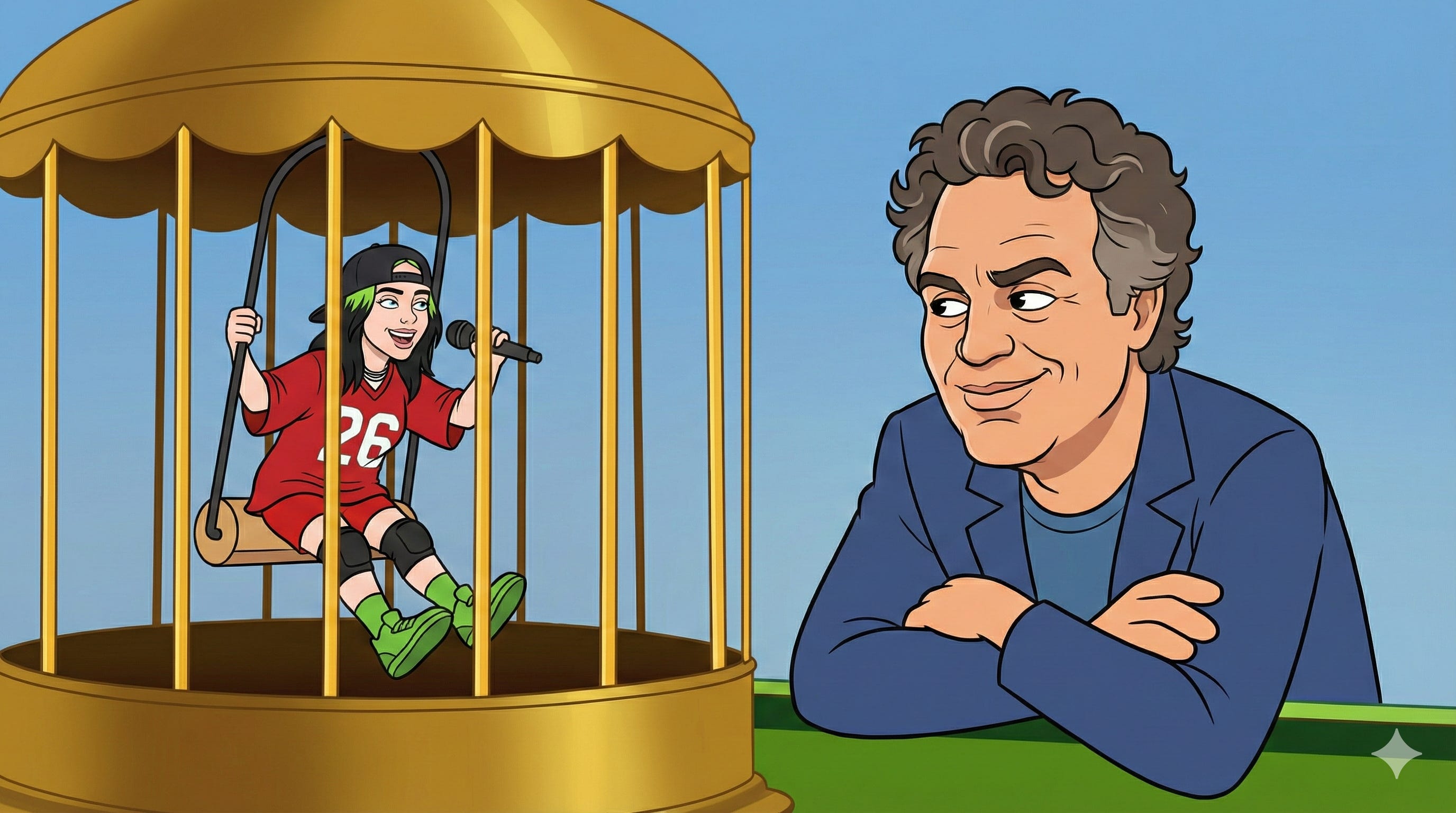
The backlash was immediate. Businessman Kevin O’Leary called it out. A spokesperson for the Tongva tribe—on whose ancestral land Eilish’s home actually sits—offered a pointed clarification: they appreciated the sentiment, but Eilish had never reached out to them directly. Mark Ruffalo jumped to her defense, telling O’Leary to “STFU” and praising Eilish for “saying something that resonates with 100’s of millions of people the world over.” Finneas lashed out at critics by invoking the Epstein files.
The people who agreed with Eilish cheered. The people who didn’t had fresh ammunition. ICE continued operating. Nothing changed.
Class, this is how celebrity activism works now: loud, heartfelt in the moment, and ultimately without consequence. Say the thing, get the applause, watch the news cycle move on.
But there’s another way to do this. Bad Bunny showed us at the Super Bowl.
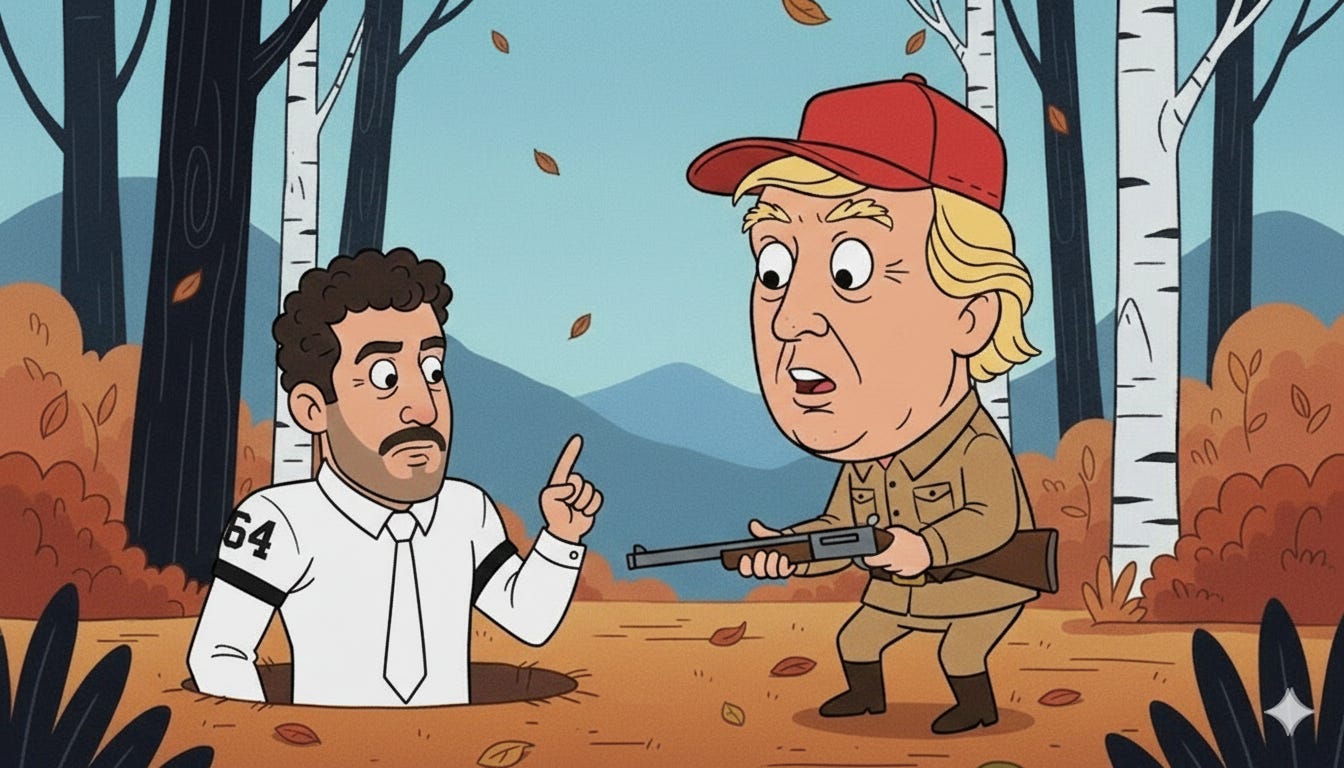
The Puerto Rican rapper emerged at Levi’s Stadium in head-to-toe white Zara—not Gucci, not Schiaparelli (who’d literally created their first menswear collection just to dress him at the Grammys the week before), but Zara. A custom faux football jersey bore his family name, Ocasio, and the number 64. Spotless chinos. Cream Adidas sneakers. He looked like an everyman who’d gotten very, very good at dressing himself.
The stage behind him was a miniature Borikén (bo-ree-ken). A pink casita (kuh-see-tah). A piragua stand. Backup dancers in traditional jíbaro regalia—all-white clothes topped with pava hats. Toñitas (toe-nye-tah), the legendary Nuyorican (newyorican) matriarch, behind a bar. Bad Bunny opened with “Tití Me Preguntó,” football in hand, and spent the next thirteen minutes proving that you don’t need to say the thing when you can simply assert your culture with such joy that even your enemies have nothing to weaponize.
I’ll confess: I had to Google almost every other word to understand what I was watching. Piragua? Shaved ice. Jíbaro? Puerto Rican farmers. Pava? The straw hat. Toñitas? A real person who runs a legendary Williamsburg bar. This is embarrassing for someone as culturally curious as I claim to be—and writing about it three days later feels a little like Wednesday morning quarterbacking. The hot takes have been taken. The think pieces have been thought. But my reaction was visceral enough that I couldn’t shake it. It kept rattling around in my head long after the confetti settled. So here we are.
But here’s what struck me: I didn’t need to understand every reference to feel what he was communicating. The performance wasn’t a translation. It was an assertion.
He perreo’d through his set, and at one point, during “MONACO,” looked into the camera and said, in Spanish, “I never stopped believing in myself, so maybe you should believe in yourself.” No lecture. No call to action. Just an invitation.
And then: a wedding.
A real couple—whose names we still don’t know—stood on stage. They’d invited Bad Bunny to their wedding. He’d invited them to the Super Bowl instead. While Lady Gaga emerged in a blue Luar flamenco dress to sing “Die With a Smile,” the couple kissed. Bad Bunny signed their marriage certificate. They cut a three-tier cake. The world watched two people get married while a Puerto Rican artist danced in the background, and somehow this felt more radical than any slogan ever could.
And none of it—not Ricky Martin’s trembling anti-colonial cameo, not the telephone poles representing an island that still loses power, or the sugar cane evoking centuries of colonial extraction—felt like a lecture. It felt like a party.
Bad Bunny closed with “DtMF,” and shouted “God bless America” while waving the Puerto Rican flag. Dancers held flags from every country in the Americas. Bunny held up a football stamped with “Together We Are America” and spiked it at the goal line. “Puerto Rico, we’re still here,” he said in his native tongue.
The jumbotron displayed the final message: “The Only Thing More Powerful Than Hate Is Love.”
Donald Trump hated it. Called it “absolutely terrible, one of the worst, EVER!” Complained that “nobody understands a word this guy is saying.” But he had nothing specific to attack. No soundbite. No slogan. Just a Puerto Rican artist performing in Spanish at the Super Bowl, building a miniature version of his homeland, marrying a couple, and dancing with so much joy that even fury had nowhere to land.
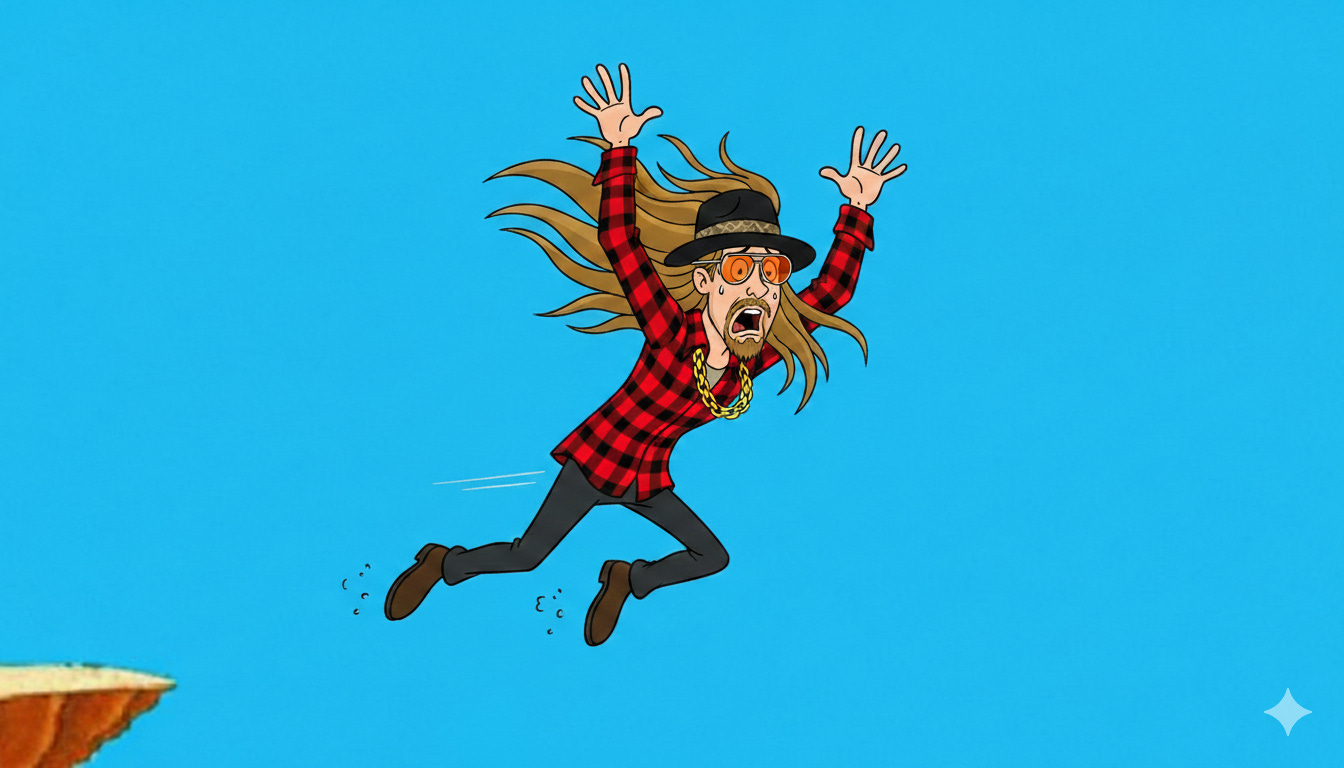
Conservative group Turning Point USA had planned a counter-halftime show: Kid Rock, Brantley Gilbert, a guitar solo of the “Star Spangled Banner,” and—according to their supporter poll—a preference for “anything in English.” Four million people streamed it on YouTube. It became a punchline.
Compare this year’s halftime event to last year’s Super Bowl featuring Kendrick Lamar. In many ways, Kendrick was doing exactly what Bunny did: he was planting a flag for his city, turning the world’s biggest stage into a masterclass in Compton history. It was technically flawless and culturally dense. But where Bad Bunny’s performance felt like an invitation to join a party, Kendrick’s felt like a closing of the ranks. He used that massive, universal platform to continue a localized, surgical beef with Drake—settling scores and litigating grievances. It was an assertion of power, sure, but it was an assertion rooted in ‘us vs. them.’ It felt small not because of the talent, but because the spirit was corrective rather than celebratory.
Bad Bunny took the high road. He could have used his thirteen minutes to attack Trump directly, to call out ICE by name, to turn the Super Bowl into a political rally. Instead, he threw a party. He celebrated his culture so loudly and joyfully that the politics became embedded in the performance itself rather than announced through it.
Even Lady Gaga’s appearance—which felt slightly shoehorned in, like a tourist speaking the native language with an American accent—couldn’t detract from what Bad Bunny understood: joy is harder to dismiss than anger. You can ignore a lecture. You can’t ignore a wedding.
At some point in the last decade, fandom became contingent on political positions. We stopped asking “Is the art good?” and started asking “Is the artist on the right side?”
Thom Yorke knows this better than anyone.
In 2017, Radiohead played Tel Aviv despite pressure from the BDS movement and artists like Roger Waters. Yorke defended the decision, calling the boycott “patronising” and “offensive,” arguing that playing in a country doesn’t equal endorsing its government. It was a principled stance: artists shouldn’t be forced to perform their politics.
Then, in 2024, a protester at Yorke’s solo show in Melbourne started shouting about “dead children.” Yorke snapped back—”come up here and say that”—and briefly left the stage. By 2025, he’d reversed his position entirely, saying he would “absolutely not” play Israel again and calling Netanyahu’s administration “extremists.”
Was this genuine evolution or coercion? Does it matter? The point is that we’ve created a culture where artists can’t just make art. They have to issue statements. Take sides. Submit to purity tests. And if they don’t, we’ll heckle them until they do. Some artists get pushed. Others, bafflingly, volunteer.
Nobody Ruffalos my feathers quite like Mark Ruffalo—and longtime readers of this Substack know this isn’t our first rodeo with the Hulk’s political alter ego. He’s passionate about Palestine, global warming, Trump, antiwar advocacy, basically everything a person can be passionate about while still maintaining a successful acting career. Which would be fine, except for one glaring detail: his last three projects have him playing cops. Now You See Me 3. Task. Crime 101. The man advocates against state violence while literally portraying agents of the state. The irony is so thick you could cut it with a nightstick.
Then there’s Primal Scream.
Last December, the Scottish indie band performed at London’s Roundhouse and screened a video during “Swastika Eyes” that showed Israeli Prime Minister Benjamin Netanyahu’s face with a Star of David entwined with a swastika in his eyes. The slogans “stop genocide” and “free Palestine” flashed across the screen. The venue apologized. The Community Security Trust reported them to police. Primal Scream defended it as “a piece of art” that “draws on history” and “provides debate, not hate.” They also called it freedom of speech and expression while shutting down the comments under their Instagram post.
But what Bobby Gillespie’s aging art rock band did wasn’t art. It wasn’t even particularly clever political commentary. It was lazy provocation masquerading as both—the kind of thing that feels radical when you’re conceiving it backstage but just looks like hatred when projected on a screen in front of actual Jewish people trying to watch a concert.
This is what happens when artists prioritize being activists over being artists. The art suffers. The activism becomes performance. And everyone gets more insufferable.
The Atlantic published an insightful piece about Bad Bunny’s Super Bowl performance, arguing that both he and MAGA are responding to the same 21st-century phenomenon: “the decoupling of culture and geography” that leaves people feeling “strangely placeless and adrift.” Bad Bunny chose joy and cultural assertion. MAGA chose protectionism and anger.
But there’s something else we’re losing in this moment: the ability to let art be art. We’ve decided that every performance must be a loyalty test, every artist must issue statements, every creative decision must be interrogated for its political implications. We’ve turned complex geopolitical conflicts into binary choices and made fandom contingent on passing purity tests.
What Bad Bunny understood—what Billie Eilish and Mark Ruffalo and Primal Scream don’t—is that the most powerful art doesn’t announce its politics. It embodies them.
Consider the wedding.
A celebration, an assertion of love in the middle of America’s biggest spectacle—it felt more radical than any slogan Billie Eilish could have shouted from a Grammy stage.
This is what performance looks like when it’s not performative. This is what resistance looks like when it’s rooted in joy rather than anger. Bad Bunny didn’t need to tell us what he stood for. He showed us. He built Puerto Rico in the middle of a football stadium. He performed entirely in Spanish. He danced with his culture on full display. He said “God bless America” while waving the Puerto Rican flag. He spiked a football that read “Together We Are America.”
The jumbotron said it best: “The Only Thing More Powerful Than Hate Is Love.”
Billie Eilish got her applause. Mark Ruffalo got his righteous retweets. Primal Scream got their controversy. And none of it mattered. None of it changed anything. The people who already agreed nodded along. The people who didn’t had fresh ammunition. The cycle continued.
Bad Bunny did something different. He created something so culturally rich, so joyful, so undeniably beautiful that even his critics had nothing specific to attack. Trump could only sputter about not understanding the words. Turning Point USA could only offer Kid Rock as a counter-programming punchline. The performance itself was bulletproof because it wasn’t asking permission. It was asserting existence.
I watched this performance and felt a kinship to Puerto Rican culture even though my proximity to it is, at best, the neighborhood where I went to college (shout out to Washington Heights). He made me empathize with the immigrant experience—not through guilt or lectures or shouted slogans, but through joy. Through celebration. Through beauty. That’s how you know it worked. That’s how you know the difference between performative activism and actual art.
“Puerto Rico, we’re still here,” he said at the end.
That’s not just better art. That’s better resistance. And if you’re an artist trying to figure out how to say something meaningful in this moment—this suffocating, exhausting, relentlessly political moment—Bad Bunny just gave you the template.
Don’t perform your politics. Make your politics into performance.
Don’t shout slogans. Build a casita.
Don’t lecture. Dance.
And if you can manage it, marry someone on stage while the world watches.
Because the only thing more powerful than hate–sincerity alert–is love. And the only thing more powerful than performative activism is art that doesn’t announce what it’s doing—it just does it, beautifully, joyfully, undeniably.
Benito Antonio Martínez Ocasio figured that out on a Sunday night in San Francisco. The rest of us are still learning how. Because when it comes to art that actually means something, we all speak the same language.


